
When we mention Green Walls, we mention as well the cities that were surrounded by vast stretches of rural areas. Nowadays, the rural population is decreasing while the urban population is constantly increasing, which leads to the rapid expansion of cities. This massive urban development is altering the Earth’s surface by concentrating materials that effectively keep heat and create impervious surfaces, thus affecting the urban microclimate and urban hydrology.
Tall buildings provide multiple surfaces to absorb solar radiation which is later re-radiated as heat, enhancing the efficiency with which urban areas are heated.
This associated with wasted heat from energy use, leads to increased temperatures in cities known as the urban heat island (UHI) effect, a precursor to other problems ranging from human health issues to high energy consumption because of the overuse of air conditioner systems. Urban areas are major concentrates and emitters of multiple pollutants resulting from human activities within the built environment. Besides these issues, other environmental and ecological problems arise because of unsustainable urban development.
As a result, new building strategies and methods are needed to reduce the adverse environmental impacts of urban infrastructures while improving their social and economic value. Urban greening initiatives are a way to achieve environmental goals while minimizing the undesirable effects of urban growth. However, the development and expansion of cities has traditionally been guided by the criterion of maximizing built area to increase profitability.
What is the Vertical Green Walls System?
Green Wall systems are also known as Vertical Garden systems. They comprise vertical structures that spread vegetation that may or may not be attached to a building facade or an interior wall. Given the level of complexity, there are many green wall patterns that range from the simplest configuration to the most complex and high-tech design. Depending on the type of vegetation and the supporting structures used, According to Maria Manso and João P. Castro-Gomes in their published paper at Renewable and Sustainable Energy Reviews Journal, these systems can be divided into two major groups: green facades and living walls.
In green facade systems, vegetation is formed by climbing plants or successive ground cover. Specially designed structures can force the development of the plant through the wall of the building, which can serve as a support for climbing plants. Typically, green fronts are rooted at the base in the ground or in plant boxes, but intermediate planters, mounted on a wall at a certain height or even on rooftops, can also be used as a fallen green sequence. Because of the lower diversity and density of plants, green facades usually require less intensive maintenance and protection than living walls. Having said that they also need a lot more time to achieve the green exterior look and are usually less impressive from an aesthetic point of view when compared to living walls.
Living walls are more complex infrastructures that include a supporting structure with different connecting methods. A waterproof backing is required to isolate the living wall from the building to avoid moisture related problems. An irrigation network is also essential while fertilization, monitoring and lighting systems are optional.
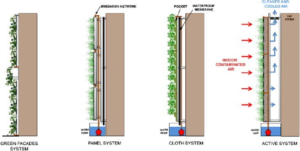
Source: Burritt, K. (2013). Survey of Suitable Plants for Cal Poly’s Green Wall.